Views: 0 Author: Site Editor Publish Time: 2026-08-11 Origin: Site
In multi-million-dollar lifting operations, massive payloads suspend high above critical infrastructure. The entire payload, facility safety, and operational continuity hinge on a single connection point—the hook. Operations Directors, EHS Managers, and Procurement teams often focus heavily on the macro crane system. They frequently overlook this micro, high-liability component. When we treat these load-bearing nodes as commoditized hardware rather than engineered safety assets, we introduce severe operational risk. Facility leaders must shift their attention to the bottom-of-the-hook reality. Selecting the right hardware requires stringent evaluation of design constraints, compliance standards, and manufacturer traceability. You will learn how to identify hidden metallurgical deficits and align your inventory with non-negotiable ASME regulations. We will also explore how to implement a rigorous inspection lifecycle to safeguard your enterprise against catastrophic failure, workflow disruptions, and severe legal liabilities.
Single Point of Failure: Hook integrity dictates total system safety; failure leads to catastrophic downtime and severe liability.
Standards Dictate Reliability: Procurement must verify alignment with strict industry standards (e.g., ASME B30.10) rather than relying on assumed load ratings.
Application Dictates Design: Assembly line efficiency and load security require specific below-the-hook adaptations, not one-size-fits-all hardware.
Vendor Vetting: A credible lifting hook manufacturer must provide transparent material traceability, proof-testing certificates, and engineering support.
A dropped load causes devastating ripple effects across an entire organization. The true cost of hardware failure extends far beyond replacing a broken part. Facility damage, immediate production halts, and potential OSHA regulatory fines quickly accumulate into millions of dollars in losses. We must view every lifting point as a primary liability vector. When a load falls, it destroys expensive machinery on the shop floor. It halts production schedules for days or weeks. Furthermore, it endangers the lives of your floor personnel.
Consider the cascading financial impact of a single catastrophic drop:
Direct structural damage to concrete foundations and surrounding equipment.
Complete loss of the suspended payload, which may be a custom-machined component worth millions.
Immediate suspension of operations pending an official safety investigation.
Exponential increases in facility insurance premiums following an incident.
Severe psychological impact on floor workers, leading to decreased morale and productivity.
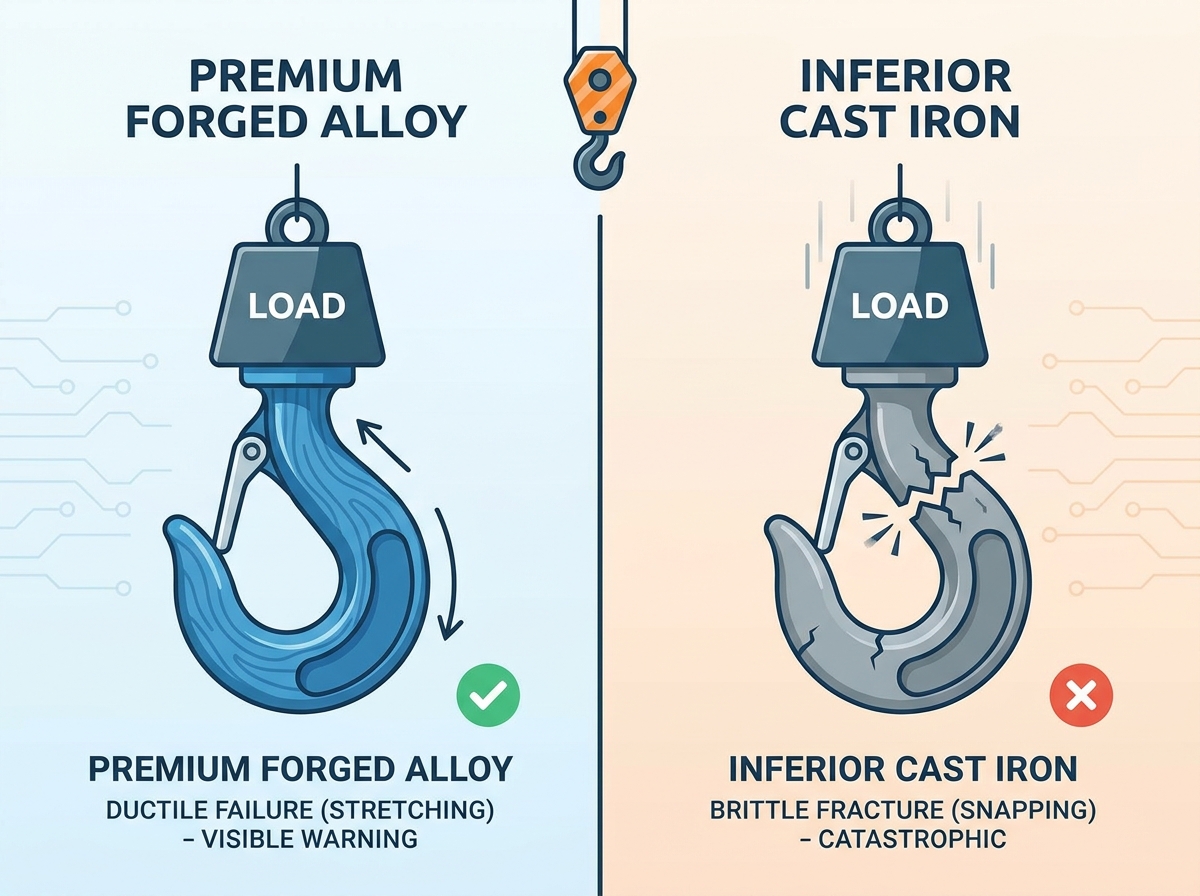
Low-cost alternatives often hide severe metallurgical deficits. Inferior metallurgy leads to premature fatigue. It encourages micro-fractures under repetitive cyclical loading. Over time, these invisible stress points compromise the load limit. Unsuspecting operators continue to hoist heavy materials daily. Eventually, the metal snaps without warning. Cheap cast metals often lack the uniform grain structure required for high-stress applications. They introduce unpredictable variables into your daily safety equations.
You should view risk mitigation as a measurable ROI metric. Investing in premium, compliant hardware directly reduces enterprise liability. It also minimizes unplanned maintenance downtime. We protect our workforce and our margins by ensuring baseline integrity at every lifting point. Quality hardware pays for itself by preventing just one catastrophic failure.
Material selection dictates how a component behaves under extreme stress. Drop-forged alloy steel provides vastly superior performance compared to lower-grade casting. We prioritize forged steel because it exhibits ductile failure. This means the metal will stretch and deform visibly before it finally breaks. Ductile failure gives operators a crucial warning sign. It allows riggers to identify a compromised component during a routine visual inspection. The forging process aligns the grain flow of the steel. This creates unparalleled strength along the primary load-bearing axis. Conversely, cast metals often suffer from catastrophic brittle snapping. They shatter instantly under overload conditions. They offer no visual warning before complete failure occurs.
Procurement teams must verify non-negotiable compliance standards. Evaluators must look for direct alignment with ASME B30.10. This standard dictates the specific design, testing, and maintenance protocols for lifting attachments. They must also ensure proper integration with ASME B30.20 for Below-the-Hook Lifting Devices. We cannot rely on assumed or unverified load ratings. Compliance frameworks demand rigorous proof testing. They require manufacturers to certify the specific working load limit (WLL) under controlled laboratory conditions. Furthermore, ASME guidelines mandate permanent identification markings forged directly into the metal.
Safety latches present a common operator pain point. Mechanical realities often plague latch design in harsh industrial environments. Latches frequently bind, bend, or become easily bypassed in the field. This completely undermines system safety. You need a robust latching mechanism. It must spring back firmly and sit flush against the tip. Flimsy stamped-metal latches deform easily when struck by heavy rigging gear. We recommend heavy-duty, cast alloy latches. They resist lateral impacts and ensure the sling remains securely captured within the saddle.
Different operational environments demand distinct architectural designs. We must differentiate requirements for fast-paced, repetitive assembly lines versus heavy, static infrastructure lifts. High-cycle operations require lightweight, highly durable profiles. These reduce operator fatigue over hundreds of manual shifts. Heavy-capacity static lifts prioritize absolute tensile strength. They manage massive, unyielding loads over extended durations.
Here is a detailed comparison of operational environments and their respective requirements:
Operational Environment | Primary Stress Factor | Recommended Material | Key Design Priority |
|---|---|---|---|
High-Cycle Assembly Line | Repetitive cyclical fatigue | Lightweight Alloy Steel | Ergonomics and rapid latch actuation |
Heavy Infrastructure Static Lifts | Massive static overloading risks | Heavy Drop-Forged Steel | Maximum tensile strength and deep saddle |
Marine/Corrosive Environments | Chemical and salt degradation | Galvanized or Stainless Steel | Corrosion resistance and sealed latches |
Integration with below-the-hook devices requires precise geometry. Spreader beams, lifting tongs, and custom fixtures must seat perfectly in the bowl. An improper fit causes unbalanced load distribution. It forces the load toward the tip. Tip-loading severely reduces the working capacity of the hardware. The saddle must match the radius of the master link or shackle used in the assembly. When hoisting large off-center loads, the attachment points experience unequal stress. Swivel designs allow the load to rotate smoothly. This prevents dangerous twisting forces from transferring into the wire rope or chain sling.
Ergonomics heavily influence operator interaction and daily safety. Well-designed profiles reduce pinch hazards during manual load attachment. They minimize operator fatigue during continuous release cycles. Engineers now incorporate recessed latch triggers. These keep the operator's fingers away from the pinch zone when a sling suddenly comes under intense tension. Reducing manual strain directly improves workflow efficiency.
Visual checks provide the first line of defense against hardware failure. We must establish strict baselines for wear and deformation. Specific deformation metrics trigger immediate replacement protocols. You cannot ignore these warning signs. Riggers must perform these crucial visual checks before every single shift.
Inspectors should follow these precise rejection criteria:
Assess the throat opening for an increase exceeding 5% of the original dimension (or 1/4 inch).
Measure for any visible twist exceeding 10 degrees from the unbent plane.
Measure the saddle base for wear exceeding 10% of the original sectional dimension.
Check the safety latch for proper spring tension and flush seating against the tip.
Examine the shank threads for any signs of stripping, severe corrosion, or physical distortion.
Critical-lift operations require advanced Non-Destructive Testing (NDT) protocols. We highly recommend magnetic particle or dye penetrant inspections. These tests identify microscopic stress fractures. Such fractures remain completely invisible to daily visual checks. Schedule these NDT evaluations annually for high-risk lifting environments. Magnetic particle testing reveals sub-surface anomalies in ferromagnetic materials. Dye penetrant testing works exceptionally well for exposing surface-breaking defects. Environmental degradation also demands attention. Rust and chemical pitting compromise structural integrity rapidly.
Never permit unauthorized modifications. Field-welding or physically altering the body introduces extreme liability. It instantly voids manufacturer load ratings. Heat from welding alters the crystalline structure of the forged steel. This severely compromises the metallurgy and guarantees future failure. If an application requires a specialized attachment point, you must consult a qualified engineer. Never attempt to weld a secondary lifting lug onto the main load-bearing body.
Vendor vetting remains the most critical phase of procurement. We must establish rigorous criteria for shortlisting suppliers. Demand verifiable proof of load testing before authorizing any purchase. You need material composition certificates for every batch. Furthermore, look for clear, permanent forging marks on the hardware itself. These marks guarantee traceability back to the origin source. A missing or illegible manufacturer mark serves as an immediate red flag. We must protect our operations from counterfeit hardware flooding the global market.
A credible lifting hook manufacturer offers comprehensive engineering and customization support. They evaluate unique load geometries carefully. They engineer custom profiles to fit specialized applications safely. They never force a standard off-the-shelf product into a compromised lifting scenario. Complex spreader beam assemblies often require non-standard throat openings. Your chosen vendor must possess the internal engineering capacity to design, test, and certify these custom solutions. ISO 9001 certification demonstrates their commitment to strict quality control processes.
Evaluate the vendor's post-sale support and recall history. Track records reveal true long-term reliability. Warranty clarity ensures you understand your coverage fully. Availability of replacement parts remains vital for operational continuity. You will inevitably need replacement OEM safety latches over time. Using aftermarket latches compromises the certified design. A reliable vendor maintains a robust inventory of replacement components. This ensures sustained compliance throughout the lifespan of your lifting assets.
The load-bearing attachment point remains the ultimate bottleneck for both safety and efficiency in any operation. A compromised connection threatens everything below it. Facility leaders carry the burden of ensuring absolute structural integrity. We cannot treat these engineered components as simple commodities.
You must prioritize verifiable engineering over initial unit cost. Strict standard compliance and manufacturer transparency secure your operational continuity. We safeguard our facilities by moving away from dangerous commodity purchasing habits. Investing in quality engineering yields measurable dividends in workplace safety and consistent production.
Take the following next steps to secure your lifting systems:
Audit your current below-the-hook inventory to identify any worn or stretched hardware immediately.
Schedule an urgent NDT inspection for all critical-lift connection points in your facility.
Consult a specialized engineer during your next procurement cycle to review unique load applications.
A: ASME B30.10 standards dictate strict rejection criteria for stretched components. You must permanently retire the hardware if the throat opening increases by more than 5% (or exceeds 1/4 inch) from its original dimension. Additionally, any visible twist exceeding 10 degrees from the unbent plane requires immediate removal from service. Never attempt to bend it back into shape.
A: Yes, custom applications often require engineered solutions. Standard off-the-shelf hardware frequently fails to provide proper load seating for unique spreader beams or specialized tongs. If the load forces weight toward the latch or tip rather than resting securely in the saddle, custom engineering becomes a regulatory necessity to maintain safe load distribution and compliance.
A: You should first inspect the hardware body for permanent identification marks. Reliable manufacturers forge their logo, traceability code, and working load limit directly into the metal. Before purchasing, request tied, traceable proof-test certificates and material composition documents. These certificates verify that the specific batch meets the rigorous testing requirements claimed by the vendor.