Views: 0 Author: Site Editor Publish Time: 2026-08-20 Origin: Site
Unplanned load releases and pinch-point hand injuries remain leading causes of severe rigging accidents across the globe. Heavy loads drop unexpectedly during routine operations. Hands get crushed between massive metal components. These catastrophic events often share a common origin point. Standard sling hooks rely heavily on spring-loaded latches. These traditional latches are highly susceptible to physical deformation, metal fatigue, and frequent operator misuse. Frustrated riggers sometimes tape latches open to speed up the process.
Upgrading to self-locking mechanisms structurally removes the reliance on fragile components entirely. It eliminates human memory from the fundamental safety equation. This engineered upgrade provides a verifiable closed loop. The connection remains fully secured under maximum tension. We will thoroughly explore the mechanics behind these common equipment failures. You will learn exactly how modern engineering prevents dangerous rollout incidents. We will also detail compliance standards, implementation strategies, and practical worksite adoption.
Engineered Safety: Self-locking hooks automatically close and lock when tension is applied, preventing accidental rollout.
Compliance & Liability: Utilizing positive-locking hardware exceeds baseline OSHA and ASME B30.10 compliance, minimizing institutional risk.
Procurement Strategy: Partnering with a vetted lifting hook manufacturer ensures metallurgical traceability, fatigue rating accuracy, and proper assembly compatibility.
Heavy industrial lifting operations demand absolute precision. They leave zero room for mechanical error. Yet, standard spring latches introduce significant physical vulnerability into daily rigging routines. These thin metal components endure immense abuse on active job sites. They frequently hit against heavy steel I-beams. They drag across rough concrete floors. Such impacts crush or bend the spring latch easily. Once deformed, the latch mechanism cannot close securely. This damage instantly compromises the integrity of your entire lift.
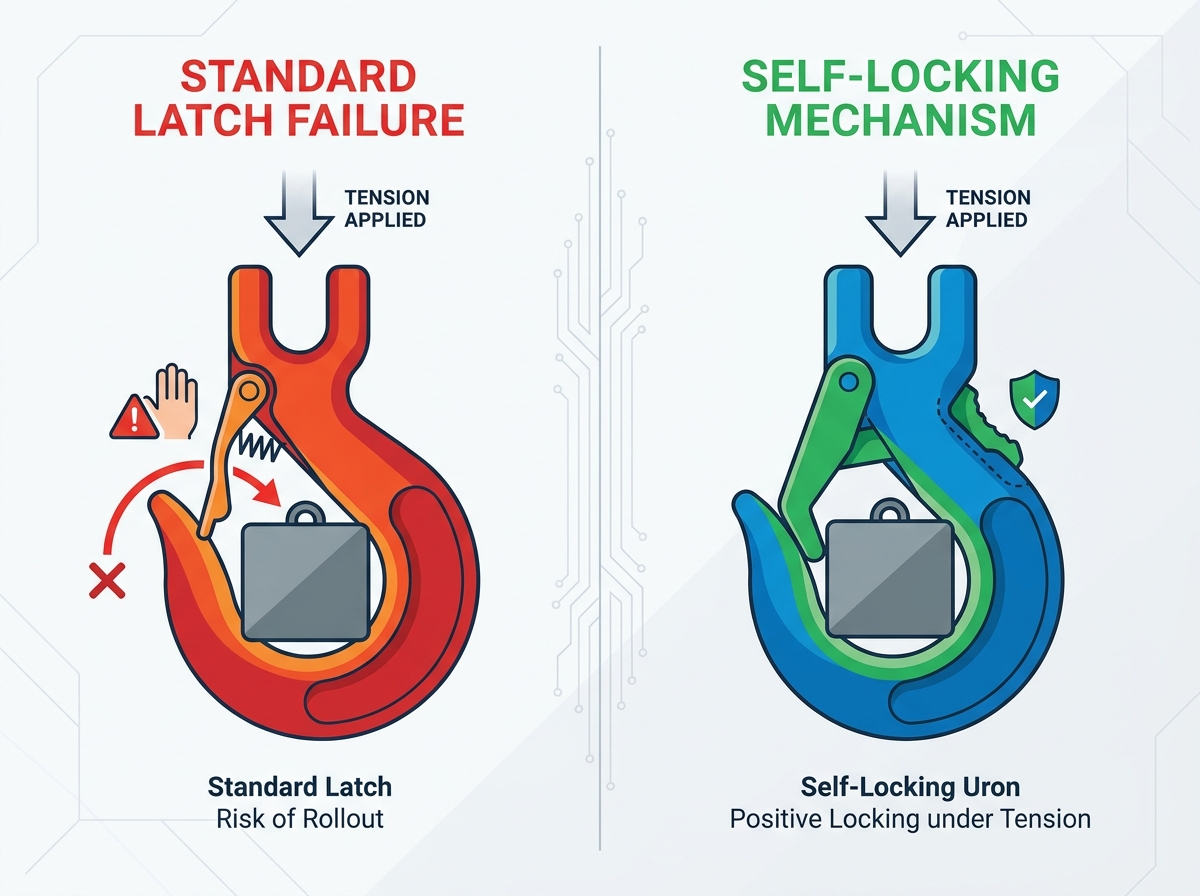
Another major structural vulnerability involves the dangerous tip loading hazard. Standard latches serve merely as a lightweight bridge. They cannot support actual load weight safely. Sometimes a synthetic sling shifts dynamically during lifting. If the rigging catches the latch instead of resting deeply in the saddle, disaster follows. The thin metal latch bends backward immediately. Catastrophic load failure becomes imminent. Rigging gear slips off the tip in seconds.
You must also account for human behavior and practical operator workarounds. Riggers often face strict operational timelines. A stubbornly jammed latch slows them down significantly. Frustrated operators frequently remove broken spring latches entirely. Sometimes they tie them back using duct tape or steel wire. These desperate actions lead directly to critical safety violations. They create undocumented risks across the entire job site. A rigged piece of hardware missing its safety latch poses a massive threat to everyone nearby.
Finally, standard hardware designs cause numerous severe pinch point injuries. Engaging a traditional model requires manual physical operation. Operators must place their fingers directly into the active crush zone. They push the spring latch open manually while aligning heavy rigging gear simultaneously. One sudden load shift crushes exposed fingers instantly. The operator has no protective barrier between their hand and the descending steel load. This outdated design practically guarantees eventual ergonomic injuries.
Self-locking designs fundamentally rewrite the industrial safety equation. They rely heavily on positive locking under tension. The unique geometric design forces the clevis or eye to physically interlock. It connects securely with the robust latch block. As active load weight increases, the locking mechanism tightens automatically. Tension directly fortifies the connection. The load itself provides the closing force. You cannot force the assembly open while under tension.
This design provides unparalleled closed-loop structural integrity. Standard spring latches serve merely as a flimsy gate. Unlike those traditional models, the self-locking latch acts as a heavy-duty element. It functions as a true load-bearing component. It securely completes the physical loop of the main body. The entire forged steel body shares the stress evenly. This distribution drastically increases the overall breaking strength. It prevents the tip from bending outward under extreme stress.
Modern self-locking units feature highly integrated recessed triggers. Release triggers sit securely flush on the back or side. They stay fully protected against the main steel body. This strategic positioning forces operators to keep hands entirely safe. You naturally grip the outside profile. Your fingers remain safely out of the active pinch zone. You disengage the heavy load without ever risking severe hand injuries. The trigger placement dictates safe ergonomic handling automatically.
Furthermore, these engineered mechanisms prevent rollout entirely. A heavy concrete load might momentarily set down during placement. The rigging could catch briefly on scaffolding or a structural obstruction. When tension slacks unexpectedly, a standard latch might pop open. Slings slip out easily during these moments. Self-locking hardware mitigates this specific risk completely. The lock stays firmly engaged until manually triggered by the operator. Even if the rigging goes completely slack, the connection remains physically locked.
Load drop mitigation represents the single greatest benefit of this technology. Transitioning to a self-locking system dramatically lowers your statistical probability of failure. Dropped loads due to accidental hardware rollout almost disappear. Engineered safety physically removes subjective human errors from daily operations. The mechanism locks itself consistently every single time. It requires no additional thought or effort from the lifting crew.
This transition also aligns perfectly with strict ASME B30.10 and OSHA standards. Baseline compliance legally requires functioning safety latches. A self-locking unit drastically simplifies your daily inspection criteria. Field inspectors face clear, unambiguous binary choices. It either closes and locks automatically, or it does not. A unit failing this simple functional test is immediately tagged out. You completely remove subjective judgment calls from site safety inspections.
Ergonomic enhancements further improve worksite safety outcomes. Many modern self-locking units feature highly integrated handling grips. You often see extended handles on larger, heavier models. Operators maneuver massive hardware easily. They never expose their hands to the dangerous crush point. Handling complex rigging assemblies becomes significantly safer and much faster.
Safety Feature | Standard Spring Latch | Self-Locking Mechanism |
|---|---|---|
Load Bearing Capacity | None. Bends under minor pressure. | High. Completes the structural loop. |
Locking Trigger | Manual spring gate in crush zone. | Recessed trigger safely away from tip. |
Rollout Prevention | Fails easily during slack tension. | Remains locked until manually released. |
Inspection Clarity | Subjective. Depends on spring tension. | Binary. Locks automatically or fails. |
To maximize these compliance benefits, consider standardizing your daily inspection routine. Following a structured checklist ensures you catch mechanical fatigue early.
Check the pivot pin: Ensure the main pin shows no signs of bending or severe corrosion.
Test the trigger spring: Press the release trigger manually to confirm strong return tension.
Inspect the saddle: Look for deep gouges or excessive wear exceeding 10% of the original profile.
Verify the automatic lock: Pull the latch open, release it, and confirm it snaps completely shut and locks.
Retrofitting existing rigging operations requires careful compatibility assessments. You must evaluate various top fittings methodically. Choose carefully between clevis, eye, or swivel top configurations. Your existing chain, wire rope, or synthetic sling setups dictate this critical choice. Mismatched fittings reduce structural capacity immediately. Using a massive clevis fitting on a delicate synthetic sling causes severe abrasion. Careful planning prevents these basic assembly errors.
You also face highly specific swivel hook considerations. Differentiation is absolutely crucial here. You must clearly distinguish between positioning swivels and true bearing swivels. Positioning swivels allow rotational alignment strictly before tensioning begins. You cannot rotate them while they support an active load. True bearing swivels feature internal heavy-duty ball bearings. They are expressly designed for continuous rotation under massive loads. Using the wrong swivel type causes rapid, dangerous mechanical failure.
Operator adoption requires patience, communication, and hands-on training. Acknowledging the initial learning curve helps improve adoption rates on site. Riggers must consciously adjust their long-standing muscle memory. They must learn to utilize the recessed trigger mechanism smoothly. Localized site training solves this temporary friction effectively. Providing hands-on practice builds team confidence quickly. Once operators experience the ergonomic benefits, resistance to the new hardware fades rapidly.
Finally, you must implement comprehensive inspection protocol updates. Internal corporate safety manuals need immediate revision. Update your documentation to include highly specific wear criteria. Inspectors must check locking pins regularly for microscopic shear damage. They need to test trigger springs for adequate, snappy tension. Latch pivot points require close visual examination for abnormal metal wear. Updating these protocols ensures the new hardware performs safely for years.
Sourcing highly reliable hardware matters immensely for site safety. Metallurgical traceability stands as an absolute non-negotiable requirement. Demand full material certifications from your chosen supplier. A reputable lifting hook manufacturer provides premium forged alloy steel consistently. They willingly supply thoroughly documented fatigue data. They present clear, certified proof-testing records for every product batch. You need verifiable proof of material strength before placing hardware into service.
You must rigorously evaluate replacement part availability. Hardware maintenance ensures maximum longevity. Assess the manufacturer’s global supply chain carefully. Can you order replacement trigger repair kits quickly and easily? Delaying urgent repairs due to constant parts shortages disrupts site operations. It forces crews to use degraded equipment. Reliable suppliers stock these essential repair kits consistently. They ship replacement pins and springs without extended delays.
Design tooling and precise physical tolerances separate premium products from cheap alternatives. Precision matters deeply in heavy rigging hardware. Evaluate manufacturers based on specific structural tolerances. Check the physical gap between the main tip and the locking latch. Excessive play indicates extremely poor manufacturing standards. Loose tolerances create dangerous potential safety gaps. A tightly machined locking mechanism guarantees positive engagement every single lift.
Examine their overall industry reputation and advanced support capabilities. Seek manufacturers offering direct engineering consultation. They should proactively help you design complex custom rigging assemblies. Their internal engineering teams must understand extreme environmental applications intimately. You might operate heavily in corrosive offshore environments. You might face extreme sub-zero temperatures daily. Expert guidance ensures you select the correct steel alloy and mechanical design for your specific conditions.
Replacing traditional standard latch models with self-locking variants changes industrial safety outcomes entirely. It remains a definitive, measurable step toward achieving zero-drop lifting operations. The engineered design physically eliminates common structural failure points. It decisively removes the dangerous variables of bent latches and operator misuse. The heavy-duty closed-loop design distributes stress safely. Recessed triggers protect hands from devastating crush injuries constantly.
Advise your internal stakeholders to take immediate action. Conduct a comprehensive rigging hardware audit across your facility. Identify all degraded standard models currently active in service. Remove severely compromised equipment from the field without hesitation. Transitioning your fleet requires an initial push, but the safety returns are undeniable. Standardization simplifies daily inspections and builds operator confidence.
Consult with certified rigging engineers today to plan your upgrade. Request an evaluation sample from a trusted supplier. Test the physical ergonomic and safety benefits on your own job sites directly. Let your most experienced riggers evaluate the locking mechanism firsthand. Verifying these concrete structural improvements directly builds immense team confidence quickly.
A: They require regular visual inspection of the pivot pin and internal trigger mechanism. You must check for accumulated dirt or physical damage. However, they entirely eliminate the frequent, frustrating replacement of flimsy spring latches. The heavy-duty design ultimately reduces overall maintenance downtime significantly.
A: No. By design, the specific geometry of the locking mechanism physically prevents the release trigger from actuating. While the assembly remains under active tension, the lock tightens further. It cannot open until the load is completely safely supported and tension is removed.
A: If it fails to lock automatically when manually closed, it requires immediate replacement. Furthermore, if it shows more than 10% wear in the saddle, exhibits extreme heat damage, or has an increased throat opening beyond specified tolerances, it must be removed from service immediately.