Views: 0 Author: Site Editor Publish Time: 2026-08-28 Origin: Site
Selecting rigging hardware represents a high-stakes risk mitigation decision rather than a routine commodity purchase. Every heavy lift relies entirely on the structural integrity of your chosen attachment point. The problem is clear. Catastrophic rigging failures rarely stem from manufacturing defects. They overwhelmingly result from misapplication, poor environmental matching, and fundamental selection errors during procurement. Overlooking dynamic forces or environmental hazards quickly turns a routine operation into a fatal disaster. We provide procurement managers, OHS officers, and rigging supervisors an evidence-based framework. You will learn how to audit your current hardware and avoid critical specification mistakes. We will also guide you on partnering with a reliable lifting hook manufacturer to ensure strict compliance. Armed with this knowledge, you can permanently eliminate dangerous guesswork from your daily rigging operations.
Understanding the difference between static Working Load Limits (WLL) and dynamic load forces is critical to preventing structural hook deformation.
Hardware incompatibility—specifically mismatched throat openings and point-loading—accounts for a significant percentage of premature lifting failures.
Vetting a lifting hook manufacturer requires looking beyond price to confirm batch traceability, fatigue testing, and adherence to ASME B30.10 or EN 1677 standards.
Standardizing your facility’s hook catalog reduces operator confusion and streamlines the pre-lift inspection process.
Dropped loads carry catastrophic consequences for any industrial operation. The fallout extends far beyond replacing a broken piece of equipment. You must consider the cascading financial impact. Damaged assets can stall entire production lines. Production downtime leads directly to missed deadlines and delayed project timelines. These direct and indirect costs cripple operational budgets rapidly. A single hardware failure can erase months of hard-earned profit margins.
Beyond immediate financial losses, severe compliance liabilities loom over negligent procurement. Regulatory bodies aggressively investigate dropped loads. OSHA and local safety authorities issue massive penalties for utilizing non-compliant rigging hardware. Underspecified components violate core workplace safety mandates. Mismatched hardware indicates a systemic failure in your safety culture. Site closures often follow serious infractions. You cannot afford to ignore these strict regulatory environments.
Many procurement teams fall into a dangerous trap. They assume all similarly rated hardware performs identically under stress. This assumption proves deadly in real-world applications. A generic component might display the correct static rating. However, it may fail completely during sudden dynamic shifts. This highlights the absolute necessity of strict evaluation criteria. You must establish rigorous vetting processes before acquiring any new lifting gear.
Rigging teams frequently commit a severe miscalculation during the planning phase. They purchase a hook based solely on the static weight of the load. They completely ignore the presence of dynamic forces. Static weight only represents a load sitting motionless. Heavy lifting operations never remain perfectly still. Cranes accelerate and decelerate. Wind gusts impact suspended loads. These factors create massive force multipliers.
Ignoring dynamic loading creates immediate danger. Shock loading occurs when a slack sling suddenly snaps tight. Abrupt crane acceleration forces the hardware to absorb immense kinetic energy. Severe sling angles further multiply the stress on the lifting point. These events can temporarily exceed the yield point of the metal. Immediate deformation follows. Once the structural geometry bends, the component loses all load-bearing integrity. You must account for dynamic multipliers during every lift plan.
Another prevalent error involves choosing the incorrect profile design. Rigging operations require specific geometries for specific tasks. Crews often use grab designs where slip designs are actually required. Sometimes they deploy standard sling profiles in applications demanding self-locking mechanisms. Each profile serves a highly specific function. You cannot substitute them based on sheer convenience.
The consequences of profile mismatches threaten entire lift plans. Improper seating of the load occurs instantly. The sling might escape the bowl entirely during temporary tension loss. This compromises the stability of the entire lift. For example, lifting loose materials requires a self-locking mechanism. A standard latch might bend and release the load mid-air. You must match the hardware profile precisely to your operational requirements.
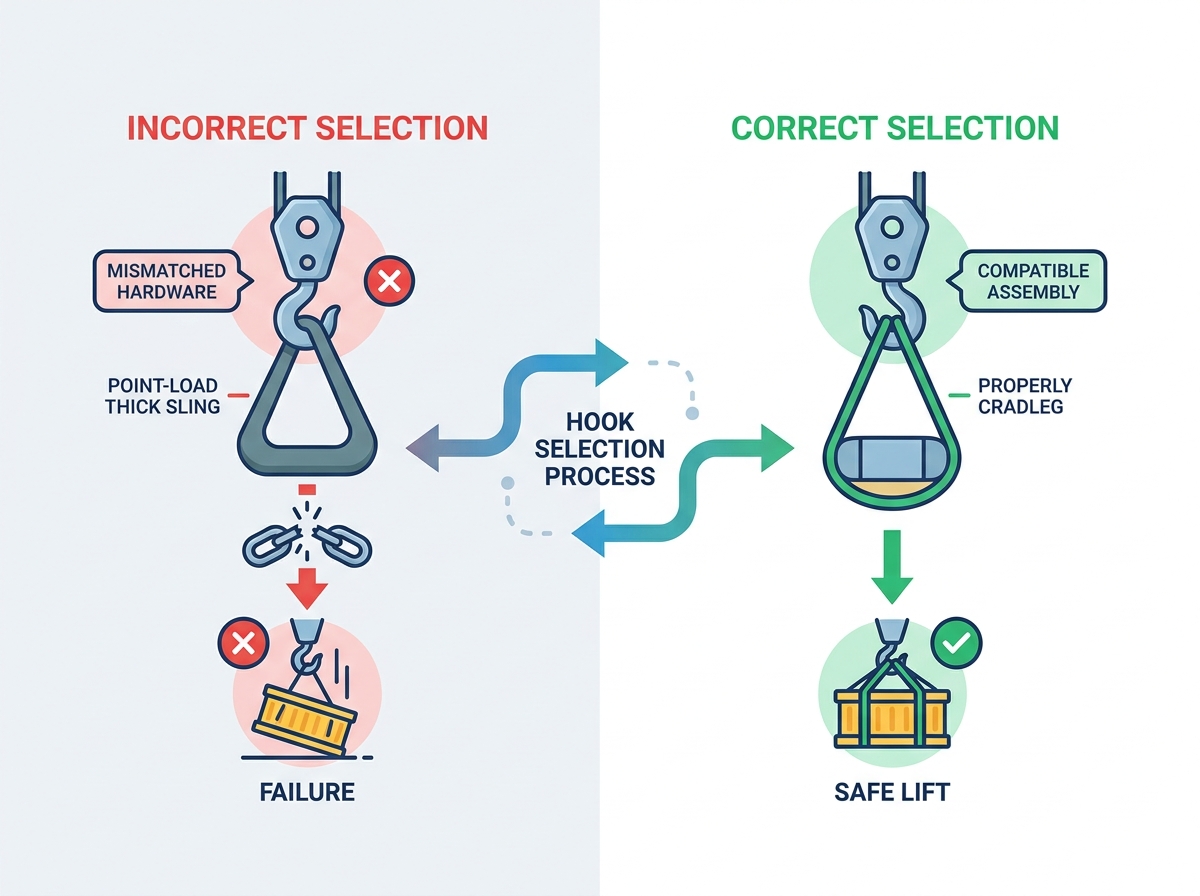
Hardware compatibility issues account for a massive share of rigging accidents. Operators frequently force oversized master links into undersized bowls. Sometimes they cram thick synthetic slings into narrow throats. Another common mistake involves attaching multiple slings to a single attachment point. Many profiles are simply not designed for multi-leg configurations. Crowding the saddle leads to disastrous structural failures.
These poor practices cause unintended point-loading. The force transfers to the tip or the safety latch. It bypasses the load-bearing saddle entirely. The saddle is the only section engineered to hold the full Working Load Limit. Point-loading drastically reduces the effective lifting capacity. A heavy-duty component can bend like soft wire under severe point-loading. You must ensure all connecting hardware mates perfectly without crowding.
Many procurement lists overlook proper safety latch specifications. Buyers often select standard models equipped with flimsy, easily bent latches. They deploy these inadequate components for overhead personnel-proximity lifts. A thin piece of stamped metal cannot secure a heavy load safely over human workers. You need robust, engineered locking mechanisms for high-risk zones.
Latch failure leads directly to accidental load release. Positive-locking (clevis self-locking) designs remain closed under pressure. They are often a strict regulatory requirement, not merely a best practice. Heavy construction sites and dynamic environments demand these advanced designs. You must consult your local safety regulations to determine mandatory latch requirements. Never cut corners on latch integrity when lives are at risk.
Environmental conditions destroy inappropriate rigging hardware over time. Corrosion and chemical exposure pose massive risks. Standard alloy steel breaks down quickly in marine environments. Acidic or highly corrosive industrial plants accelerate this degradation. Deploying standard steel in these areas invites sudden failures. You must specify proper protective finishes or deploy stainless steel alternatives. They resist aggressive chemicals and salt spray effectively.
Extreme temperature fluctuations also compromise metal integrity. Excessive heat alters the tensile strength of forged steel. It damages the temper of Grade 80 and Grade 100 alloys. High-heat foundries require specialized hardware to prevent heat-induced stretching. Conversely, extreme cold introduces severe brittleness. Standard alloys can shatter under shock loads in sub-zero environments. You must match the metallurgical properties to your facility's climate.
Application-specific grading dictates overall safety and performance. You must choose between Grade 80, Grade 100, and Grade 120 based on precise criteria. Higher grades offer better strength-to-weight ratios. This reduces operator fatigue during manual rigging. However, higher grades may lack the necessary ductility for certain dynamic applications. Assess your environmental constraints carefully before selecting a steel grade.
The following table outlines standard grade comparisons for rigging hardware selection:
Steel Grade | Primary Application Profile | Relative Strength Ratio | Environmental Limitations |
|---|---|---|---|
Grade 80 | General heavy lifting and overhead rigging. | Standard baseline strength. | Vulnerable to extreme heat exceeding 400°F. |
Grade 100 | High-capacity lifts requiring lighter hardware. | 25% stronger than standard Grade 80. | Requires strict visual inspection for surface wear. |
Grade 120 | Extreme load applications prioritizing low weight. | 50% stronger than standard Grade 80. | High hardness reduces ductility; avoid heavy shock loads. |
Vetting your supplier acts as your first line of defense. You must look far beyond standard promotional materials. Manufacturing transparency matters immensely. Assess whether the supplier utilizes in-house drop forging. Drop forging provides consistent grain flow throughout the metal. This ensures maximum structural integrity. Avoid suppliers relying heavily on outsourced casting. Castings remain highly susceptible to hidden internal voids and microscopic cracks.
You must demand rigorous proof testing and certification. Require documented evidence of proof-testing for every batch. Reputable facilities typically test at 2x to 2.5x the stated WLL. They should willingly provide testing certificates. Ensure strict compliance with international standards like ASME B30.10, OSHA, or EN 1677. A reliable lifting hook manufacturer embraces independent auditing and publishes their safety data transparently.
Traceability guarantees long-term accountability. High-quality hardware features permanent, forged-in markings. These markings indicate Size, Grade, WLL, and a traceable Batch Code. You can trace a failure directly back to the production date. Avoid any suppliers using painted-on specification stamps. Do not purchase hardware missing clear identification markings. Unmarked metal belongs in the scrap bin.
Finally, evaluate their overall engineering support. Elite manufacturers provide more than just raw metal. They offer comprehensive technical documentation and detailed usage guidelines. They assist your team in designing custom engineering for non-standard lifting configurations. This partnership approach prevents catastrophic misapplications. Solid engineering support proves invaluable when tackling complex rigging challenges.
Introducing new rigging hardware requires systematic execution. You cannot simply dump new gear into the tool crib. Begin by conducting a comprehensive site-wide audit.
Locate all rigging hardware currently circulating in your facility.
Identify obsolete, deformed, or non-compliant components.
Quarantine these dangerous items immediately.
Destroy them physically to prevent accidental reuse.
Thorough destruction guarantees that compromised equipment never returns to the active inventory.
Next, you must update your pre-lift Standard Operating Procedures (SOPs). Training rigging crews ensures proper utilization of the new hardware. Focus on specific visual inspection cues for the newly adopted types. Teach them how to measure throat spread accurately. Show them how to identify acceptable wear limits in the bowl. Practical training prevents improper loading techniques. It empowers workers to reject damaged gear before initiating a lift.
Standardizing the supply chain solidifies your safety protocols. Align your OHS requirements directly with procurement protocols. This alignment creates a secure purchasing pipeline. It ensures unauthorized, off-brand replacements never enter the facility. Discarded catalogs and unapproved vendors introduce massive risk. Strict standardization streamlines inspections and eliminates operator confusion on the floor.
Proper hardware selection bridges the critical gap between theoretical load charts and real-world operational safety. A simple hook failure carries enough destructive potential to halt operations and incur massive regulatory fines. You must prioritize dynamic load limits over static weight guesses. Furthermore, ensure total hardware compatibility and demand strict manufacturing traceability.
We urge you to take immediate action today. First, audit your current rigging hardware inventory to identify non-compliant components. Second, destroy any deformed or unmarked gear immediately. Finally, initiate technical discussions with a certified lifting hook manufacturer to close your compliance gaps. Upgrading your procurement standards ensures maximum safety and zero compromises.
A: No. Heating or welding a forged alloy hook permanently destroys its metallurgical integrity and voids all load ratings. It must be destroyed and replaced.
A: Requirements vary by jurisdiction (e.g., OSHA standards), but self-locking hooks are generally mandated in heavy overhead lifting, dynamic environments, and construction sites where the risk of the load catching and releasing is high.
A: While a visual inspection is required before every lift, a documented, comprehensive inspection by a qualified person must occur at least annually, or more frequently based on severity of service.
A: Yes. The entire lifting assembly is only as strong as its weakest component. Using a Grade 80 hook on a Grade 100 chain downgrades the entire assembly's capacity to Grade 80.