Views: 0 Author: Site Editor Publish Time: 2026-09-04 Origin: Site
Heavy lifting carries incredibly high stakes on any industrial job site. Choosing the wrong suspension equipment compromises load integrity, workplace safety, and strict regulatory compliance. One single failure can trigger catastrophic accidents and massive operational delays. You often face a choice between flat woven belts and tubular loop designs. Both are highly versatile synthetic solutions used across multiple industries. However, their structural differences dictate vastly different performance limits, wear patterns, and ideal hitching methods. Relying on guesswork or using them interchangeably creates severe hidden risks.
This article provides a strict, evidence-based evaluation framework. Site managers and professional riggers will learn how to select the exact synthetic lifting slings needed for their specific operational demands. We will break down essential capacities, inspection rules, and hitching profiles. You will discover actionable insights to optimize safety, extend equipment lifespan, and maximize performance every time you execute a lift.
Structure Dictates Application: Flat webbing slings provide a wide bearing surface for fragile loads, while endless round slings offer superior flexibility and higher Working Load Limits (WLL) for heavy, abrasive, or cylindrical loads.
Choke Hitch Efficacy: Round slings grip loads more securely in a choke hitch without the edge-creasing risks associated with flat webbing.
Wear Profile: Both are highly susceptible to sharp edges and require edge protection, but round slings feature a protective outer jacket that shields the load-bearing core yarn from immediate UV and abrasion damage.
Compliance is Universal: Regardless of type, both must strictly adhere to color-coded WLL standards (e.g., ASME B30.9 or EN 1492-1/2) and rigorous daily inspection protocols.
Synthetic rigging equipment provides a lightweight, non-marring alternative to traditional steel chains or wire rope. Riggers prefer them to prevent scratches on delicate surfaces. We can categorize these tools into two distinct architectural designs. Each design relies on high-tenacity synthetic yarns to bear heavy weights. Polyester, nylon, and polypropylene dominate the manufacturing market. However, manufacturers arrange these fibers quite differently. Your choice of fiber arrangement drastically changes the overall performance profile.
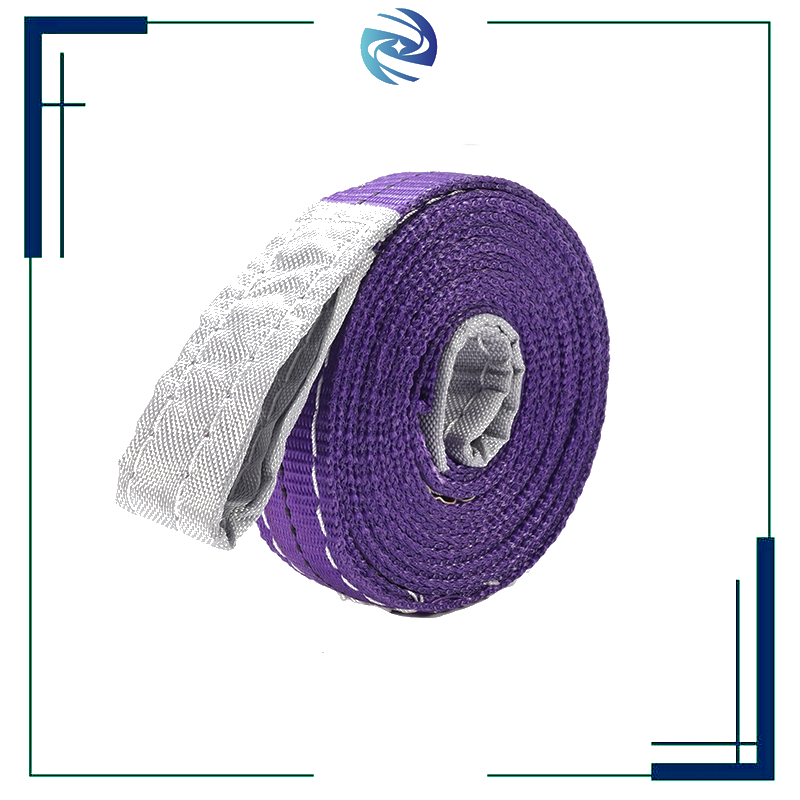
Flat woven architecture involves a tightly woven construction process. Manufacturers weave the load-bearing yarns into a wide, flat belt. The working environment directly exposes these structural yarns to UV rays, dirt, and friction. You will often see them built in single layers known as Simplex. Sometimes manufacturers sew two layers together, creating a Duplex design. They usually feature reinforced loop eyes sewn at each end for easy crane hook attachment.
Tubular loop architecture takes a completely different engineering approach. It features a continuous, endless loop of load-bearing core yarns. A tightly woven tubular jacket encases this polyester core entirely. This outer jacket bears zero load during a lift. It acts strictly as a protective shield against the elements.
Why does this structural divide matter so much? The core exposure directly drives your daily maintenance strategy. Enclosed cores stretch differently under tension. Exposed woven belts suffer from different surface abrasion patterns. Recognizing this internal architecture helps you establish much safer inspection routines.
Let us evaluate the primary advantages of woven belt designs. Flat webbing slings excel heavily at load distribution. Their wide surface area spreads the lifting force efficiently across the object. This wide footprint minimizes intense pressure points on fragile or crush-sensitive loads. You will find them absolutely ideal for lifting machined metal parts. They also perform beautifully when hoisting fiberglass boats or pre-fab architectural components. They protect finished surfaces better than almost any other rigging tool.
They also offer incredible ease of inspection. The structural load-bearing material remains completely exposed to the naked eye. Riggers can spot surface cuts immediately during morning checks. Abrasions, chemical burns, or broken stitches stand out visually. You do not have to guess about hidden internal damage. If the belt looks compromised on the outside, you know the strength is compromised.
However, you must actively manage specific implementation risks. Woven belts are highly vulnerable to cutting forces. Sharp load corners will sever the tensioned fibers instantly. You must use rigid edge protectors on any 90-degree corner.
Furthermore, they perform less effectively in a choke hitch application. The flat belt naturally tends to bunch up. It creases heavily around the choke point under tension. Over time, this repeated creasing breaks down the structural integrity of the fibers.
Best Practice: Always lay the woven belt completely flat against your load. Do not allow any twists in the material during initial tensioning. A twisted belt reduces the overall capacity severely.
Next, we evaluate continuous loop designs. Endless round slings deliver exceptional capacity alongside incredible flexibility. They safely handle exceptionally high Working Load Limits. You can easily source specialized models rated for upwards of 100 tons. Their compact nature makes them easier to store than massive wire rope assemblies of equal strength.
The endless loop design offers a massive operational lifespan advantage. You can physically rotate the loop between every single lift. This action constantly shifts the active wear points. Shifting these wear points prevents premature friction failure in one spot. It significantly extends your overall operational ROI.
They also provide superior hitching performance across diverse environments. The tubular shape molds seamlessly around highly irregular objects. You can quickly wrap them around steel pipes, wire coils, or raw timber bundles. They bite down firmly in a choke hitch. Unlike flat belts, they do not crease or lose internal strength when choked tightly against themselves.
Still, they carry distinct and severe implementation risks. Hidden damage remains your absolute biggest concern. The protective jacket completely obscures the internal core yarns. You might have a slightly punctured jacket covering completely severed core fibers.
Common Mistake: Riggers sometimes ignore small jacket tears. If the jacket is punctured, cut, or severely frayed, you must remove the unit from service immediately. Do not assume the core remains perfectly intact.
Additionally, you must consider load crushing risks. A tubular design has a much narrower contact area under tension. It can apply intense, focused pressure against the load. This high pressure might damage fragile or soft edges.
Site managers need quick reference points to make safe decisions. We compiled the distinct differences into a straightforward comparative format. Review the table below before authorizing your next major rigging purchase.
Quick Decision Matrix for Synthetic Rigging
Evaluation Criteria | Woven Flat Belts | Continuous Tubular Loops |
|---|---|---|
Ideal Load Shape | Best for flat, smooth, wide, or fragile surface areas. | Best for cylindrical, highly irregular, or rugged industrial shapes. |
Capacity & Scaling | Tops out at lower/mid-range tonnages. Higher capacities become impractically wide. | Easily scales to massive tonnages (100+ tons) while remaining very compact. |
Wear Distribution | Fixed wear points localized entirely at the eyes and center bearing point. | Variable wear points. The endless loop allows continuous rotation. |
Cost vs. ROI Profile | Lower initial replacement cost. Shorter lifespan on abrasive jobs. | Higher initial durability. Longer lifespan heavily reduces frequent replacement costs. |
When assessing Cost vs. ROI, avoid looking only at the initial purchase price. Both styles often share similar upfront costs at lower tonnages. True ROI depends on your daily application. If you lift highly abrasive steel bundles daily, tubular loops offer a better return. The rotational wear points delay structural failure. Conversely, if you lift delicate aerospace components, woven belts prevent costly load damage. Protecting your expensive cargo always yields the highest return.
Rigorous compliance ensures every heavy lift ends safely. Both rigging styles adhere to a universal international color-coding standard. This visual system helps riggers identify safe capacities instantly on the floor.
For example, a violet exterior always indicates a 1-ton limit. Green represents 2 tons. Yellow signifies 3 tons. This system accurately conforms to European EN 1492-1/2 manufacturing standards. However, relying solely on exterior color is incredibly dangerous. Sun exposure fades these vibrant colors rapidly. Job site dirt easily obscures the dye. You must always verify the printed identification tag before hoisting.
We must address the single leading cause of synthetic rigging failure: sharp load edges. Neither design naturally resists sharp metal corners. Edge protection is absolutely mandatory across all applications. You must utilize cut-resistant polyurethane sleeves. Magnetic synthetic corner protectors also provide excellent barriers against sheer forces. Never skip this vital safety step.
Retirement criteria dictate exactly when to destroy aging equipment. Safety frameworks like OSHA and ASME B30.9 provide strict regulatory guidelines. Practical experience shows you must reject and destroy the equipment if you observe any of the following conditions:
Missing, torn, or completely illegible manufacturer ID tags.
Acid, alkali, or unknown chemical burns across the surface.
Signs of melting, charring, or weld spatter damage.
Punctured holes, severe tears, or deep abrasive cuts.
Broken, heavily worn, or unraveled stitching in load-bearing splices.
Do not attempt to repair torn synthetic fibers. Once you identify critical damage, cut the gear into pieces. This prevents another worker from retrieving it from a trash bin.
Selecting the proper gear requires careful mathematical calculation. You cannot guess load weights or sling angles. Follow this specific four-step process to specify your equipment accurately.
Calculate the Maximum Load Weight: Always account for the dynamic load forces, not just the static dead weight. Sudden crane jerks multiply the forces applied to your rigging. Consult accurate shipping manifests or engineered drawings.
Determine the Hitch Type: Decide between a vertical, choker, or basket hitch. Remind your team constantly: the working capacity changes drastically based on the hitch angle. A choker hitch significantly reduces your rated capacity. A basket hitch generally doubles it.
Assess the Load Geometry: Match the sling architecture to the object shape. Choose woven flat belts for fragile, flat surfaces. Select continuous tubular loops for highly irregular, heavy, or cylindrical loads.
Factor in the Environment: Assess ambient chemical exposure. Evaluate UV degradation risks. Check operating temperatures. Confirm your chosen polyester or nylon material resists the specific chemicals present in your facility.
You rarely have to make these calculations completely alone. Prompt your purchasing managers to consult directly with an engineering or sales team. Specialists can calculate complex rigging geometries accurately. They will help you source fully compliant assemblies tailored directly to your facility.
Neither synthetic sling design proves universally superior in every scenario. The correct choice always comes down to your specific load geometry, accurate weight calculations, and required hitching methods. Woven flat belts excel at protecting delicate surfaces by spreading pressure evenly. Tubular loops deliver unmatched capacity, rotational wear resistance, and superior choker hitch performance.
Your final operational advice is simple: prioritize absolute load stability and strict regulatory compliance over marginal upfront cost savings. Never compromise on edge protection. Implement mandatory daily visual inspections across your entire job site.
Take action today to secure your lifting operations. Encourage your site managers to browse the full product catalog. Download a comprehensive hitch capacity chart for your rigging teams. Contact a dedicated rigging specialist right now to engineer custom lifting assemblies for your toughest jobs.
A: We generally discourage this practice. Different materials and structural designs exhibit vastly different stretch characteristics under heavy tension. This uneven elongation can easily cause dangerous load shifting mid-air. You should only mix styles if a qualified engineer specifically designs and approves the exact rigging plan.
A: Yes, regarding peak manufacturing limits. Manufacturers can build continuous core constructions to handle vastly higher tonnages. While flat belts usually cap out at moderate weights before becoming impractically wide, tubular designs easily scale up to 100 tons or more while remaining compact.
A: You must place rigid physical barriers between the tensioned synthetic fibers and the load edge. Detail your rigging plan to include thick polyurethane sleeves, reinforced webbing wear pads, or heavy-duty magnetic corner guards. These accessories prevent immediate severing under high tension.
A: You must mandate immediate removal from service. Strict compliance standards globally prohibit using any rigging equipment without verifiable capacity limits and manufacturer traceability. Cut the untagged unit into pieces and discard it to prevent accidental reuse by other workers.