Views: 0 Author: Site Editor Publish Time: 2026-09-11 Origin: Site
Selecting industrial lifting equipment represents a high-stakes operational decision. Under-speccing this equipment creates immediate risks for catastrophic failure. Conversely, over-speccing bloats your capital expenditure without adding real value. Matching hoist specifications to actual facility workflows often proves incredibly complex. Static manufacturer charts routinely fail to account for dynamic loads. They also ignore the harsh realities of environmental wear inside busy plants.
We designed this guide to bridge the gap between static data and dynamic application. We provide a strict, engineering-aligned evaluation checklist for procuring your next lifting system. You will explore the four critical pillars of hoist selection. These pillars include load capacity, true lift height, motor duty cycle, and power supply requirements. Mastering these variables ensures you deploy safe, compliant, and highly efficient lifting solutions.
Capacity requires a buffer: Always calculate Safe Working Load (SWL) by factoring in dynamic loads, not just static weight.
Duty cycle dictates lifespan: Matching HMI/FEM classifications to your actual operational frequency prevents motor burnout and premature brake failure.
Headroom defines lift capabilities: Lift height must account for structural facility limitations, hook block dimensions, and load clearances.
Power supply dictates performance compatibility: Accurate phase and voltage matching, along with control voltage safety, is non-negotiable for stable operations.
Buying lifting equipment requires a strategic mindset. Initial purchase prices only represent a fraction of the overall procurement reality. You must weigh the cost of failure against the cost of acquisition. Initial savings gained from purchasing lower-rated electric chain hoists vanish quickly during breakdowns. High-volume applications aggressively punish undersized motors. Maintenance downtime and early replacement costs easily outpace any initial discount you secured.
You need to establish strict success criteria before contacting vendors. A successful procurement actively mitigates safety risks on the plant floor. It adheres rigorously to local compliance frameworks like OSHA, ASME B30.16, or European FEM standards. Furthermore, the new equipment must integrate seamlessly. It should attach flawlessly to your existing trolley setups or overhead crane infrastructure.
Facilities often face the choice of upgrading legacy equipment. You might currently rely on manual chain falls or pneumatic systems. Transitioning to motorized chain hoists becomes necessary when production demands higher throughput. Motorized units offer vastly superior positioning precision. They reduce operator fatigue and accelerate repetitive lifting tasks significantly.
Engineers consistently differentiate between static and dynamic loads. Static weight simply measures the object at rest. Dynamic loads introduce complex physical forces. Sudden stops during a descent multiply the effective weight on the suspension system. Load swinging and structural impact forces further stress the internal gearing. You cannot simply match a two-ton static load to a two-ton hoist.
Industry best practice dictates applying the 25% rule. Engineers strongly recommend adding a 25% capacity buffer to your heaviest anticipated load. If your maximum component weighs 4,000 pounds, you should evaluate a 5,000-pound capability. This buffer absorbs shock loads safely. It also prolongs the lifespan of internal braking mechanisms.
Understanding your use case drives accurate selection. Standard capacity models suit intermittent machine shop tasks perfectly. However, demanding environments require a different approach. Continuous steel processing or automotive assembly lines run constantly. In these scenarios, you must specify a heavy-duty electric chain hoist. These rugged units feature reinforced gearing and superior heat dissipation.
Calculating your true lift requires precise measurements. Do not measure only the distance from the floor to the beam. True lift spans the distance from the load's lowest resting point to the highest required elevation. You must also factor in the length of your rigging. Slings, spreader beams, and lifting tongs consume valuable vertical space.
Headroom limitations present a common installation hurdle. Headroom defines the physical distance between the hoist's top suspension point and the saddle of the bottom hook when fully retracted. Low headroom environments force compromises. You might need specialized low-headroom trolley designs to clear ceiling obstructions.
You also need to evaluate chain fall configurations. Single-fall designs utilize one continuous chain. They offer faster lifting speeds and a smaller physical footprint. Multi-fall designs loop the chain through a bottom block. This doubles the capacity but cuts the lifting speed in half. Multi-fall configurations also require more frequent inspection of the bottom block sheaves.
Motor duty cycle heavily influences equipment longevity. You define the cycle by calculating two metrics. First, determine the maximum number of motor starts per hour. Second, calculate the maximum continuous on-time. Continuous 30-minute runs generate different thermal profiles than frequent two-minute jogs. Excessive jogging burns out contactors rapidly.
You must map your facility workflow to proper standard classifications. Standard service fits intermittent usage well. Severe service handles aggressive production schedules. The Hoist Manufacturers Institute (HMI) provides clear guidelines. HMI Class H3 suits general machine shop applications. H4 or H5 classifications become mandatory for high-volume automated manufacturing.
Thermal protection remains absolutely vital for high-duty operations. Aggressive usage generates immense internal heat. We highly recommend integrating thermal overload sensors directly into the motor windings. These sensors automatically shut down operation if temperatures exceed safe thresholds. This inexpensive feature prevents catastrophic motor burnout.
Table: Quick Reference for Duty Cycle Classifications
HMI Class | FEM Standard | Max Starts/Hour | Max On-Time (Minutes/Hour) | Typical Application |
|---|---|---|---|---|
H2 | 1Bm | 150 | 15% (9 mins) | Light maintenance, intermittent use |
H3 | 1Am | 300 | 25% (15 mins) | General machine shop, assembly |
H4 | 2m | 300+ | 30% (18 mins) | Heavy warehousing, continuous fabrication |
H5 | 3m | 600+ | 50%+ (30+ mins) | Automated processes, bulk handling |
Matching motors to your facility power grid sounds simple but requires diligence. Single-phase 115/230V setups work for light commercial spaces. However, industrial reliability demands three-phase power. Three-phase 230/460V motors draw less amperage per phase. They run cooler and deliver much smoother torque during heavy lifts.
Control voltage safety is non-negotiable. Operators handle the pendant controller constantly. Sending high-voltage main power down the pendant cord creates a lethal shock hazard. You must step down the control voltage using an internal transformer. Dropping the pendant voltage to 24V or 115V protects operators from electrical faults.
Speed selection directly impacts operational efficiency and load safety. You have three primary options:
Single-speed: Ideal for basic, unobstructed lifting tasks where precision matters less.
Dual-speed: Features a fast speed for bulk transit and a slow "creep" speed. This enables precise positioning for die changes or assembly.
Variable Frequency Drives (VFD): Provides programmable, infinitely variable speeds. VFDs deliver ultra-smooth acceleration and deceleration. They prevent fragile loads from swinging or bouncing.
Environmental factors destroy lifting equipment faster than heavy loads. You must select proper Ingress Protection (IP) ratings based on your facility atmosphere. IP55 ratings offer sufficient protection against standard dust ingress and basic water splashes. If your facility uses corrosive chemicals or high-pressure washdowns, you need an IP65 rating or higher. Completely sealed housings prevent internal electrical corrosion.
Extreme temperatures demand specialized modifications. Standard lubricants break down rapidly in foundries or steel mills. You will need heat shields and high-temperature gear grease. Conversely, cold-storage facilities present different challenges. Condensation freezes inside the motor housing. In these environments, you should specify internal motor heaters to keep the coils dry.
Suspension methods dictate how the unit traverses your facility. Hook-mounted setups remain stationary. They work perfectly for fixed workstation lifting. Push trolleys allow operators to manually glide light loads along an I-beam. Motorized trolleys become essential for heavy or frequent travel. They prevent operators from dangerously pushing massive loads by hand.
Modern lifting equipment incorporates sophisticated safety mechanisms. You must distinguish between standard necessities and optional upgrades. Friction clutches serve as vital overload protection. They slip intentionally if an operator attempts to lift an excessive weight. Upper and lower limit switches prevent the hook block from smashing into the hoist body or unwinding completely. Electromagnetic fail-safe brakes immediately lock the load in place during unexpected power failures.
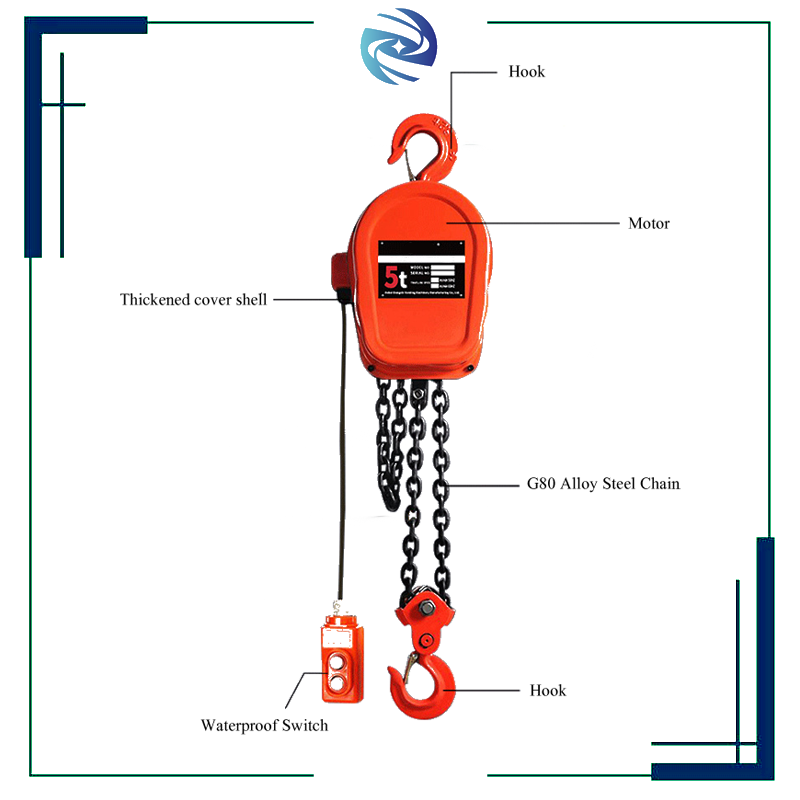
Chain quality directly correlates with workplace safety. Industrial applications typically specify Grade 80 alloy steel chains. For highly abrasive environments, Grade 100 surface-hardened chains offer superior wear resistance. You should also mandate the use of chain containers. Loose slack chain creates a severe hazard. It can snag on machinery below or jam inside the internal load sheave.
Implementation realities often expose structural weaknesses. You must verify the structural load capacity of your existing I-beam, jib crane, or gantry. Do not assume older beams can handle modern equipment. The supporting structure must safely accommodate the new SWL. It must also support the dead weight of the motorized unit and the trolley system.
Vendor evaluation requires looking past marketing brochures. Seek out manufacturers who provide transparent load testing documentation. Every unit should undergo rigorous factory testing before shipment. Availability of OEM spare parts guarantees long-term viability. Furthermore, scrutinize their established warranty terms. Strong warranties indicate high confidence in their motor and brake designs.
You must gather exact facility data before requesting quotes. Vendors cannot specify the right equipment without hard numbers. Create a checklist of necessary metrics. Document your facility's exact operating voltage and phase. Measure the precise flange width of your existing beams. Calculate your expected duty cycle based on daily operational shifts.
Do not guess when finalizing your specifications. You should actively leverage a manufacturer's technical sales team. Securing chain hoist selection support allows engineers to audit your application thoroughly. They will validate your mathematical assumptions regarding dynamic loads and duty cycles. This expert validation prevents costly mistakes before you issue a formal Purchase Order.
Selecting the optimal lifting solution functions primarily as an exercise in risk management. You must secure accurate data regarding load capacities, duty cycles, and environmental constraints. Ignoring any of these dimensions invites operational bottlenecks and safety hazards. Strict adherence to proper engineering calculations ensures your equipment performs reliably under demanding conditions.
Take immediate action to safeguard your upcoming procurement. First, physically measure your existing beam dimensions and headroom clearances. Next, conduct a thorough audit of your maximum anticipated load weights, factoring in dynamic forces. Finally, reach out to technical engineering teams for application-specific validation and professional quoting. This methodical approach guarantees a safe and productive lifting environment.
A: Heavy-duty models feature superior motor housing heat dissipation and reinforced internal gearing. They usually carry higher duty cycle classifications (H4 or above). This allows them to run continuously in demanding environments without overheating. Standard models are designed for intermittent, lighter-duty applications.
A: You calculate it by determining the average operating time per day and the maximum number of motor starts per hour. You also need to measure the length of standard lifts. This data points you toward the correct HMI or FEM classification, ensuring the motor survives your workflow.
A: Chain designs offer a much more compact physical footprint and true vertical lift. They do not suffer from the lateral hook drift common in wire rope systems. Furthermore, they are significantly more cost-effective and easier to maintain at sub-5-ton lifting capacities.
A: Single-phase power works adequately for light-duty or intermittent use. However, three-phase power is strongly recommended for sustained, heavy industrial lifting. Three-phase motors prevent excessive current draw, reduce heat generation, and provide smoother torque for heavy loads.